Flavor Agent — demo
Part of the Flavor Agent case study · see also the governance model.
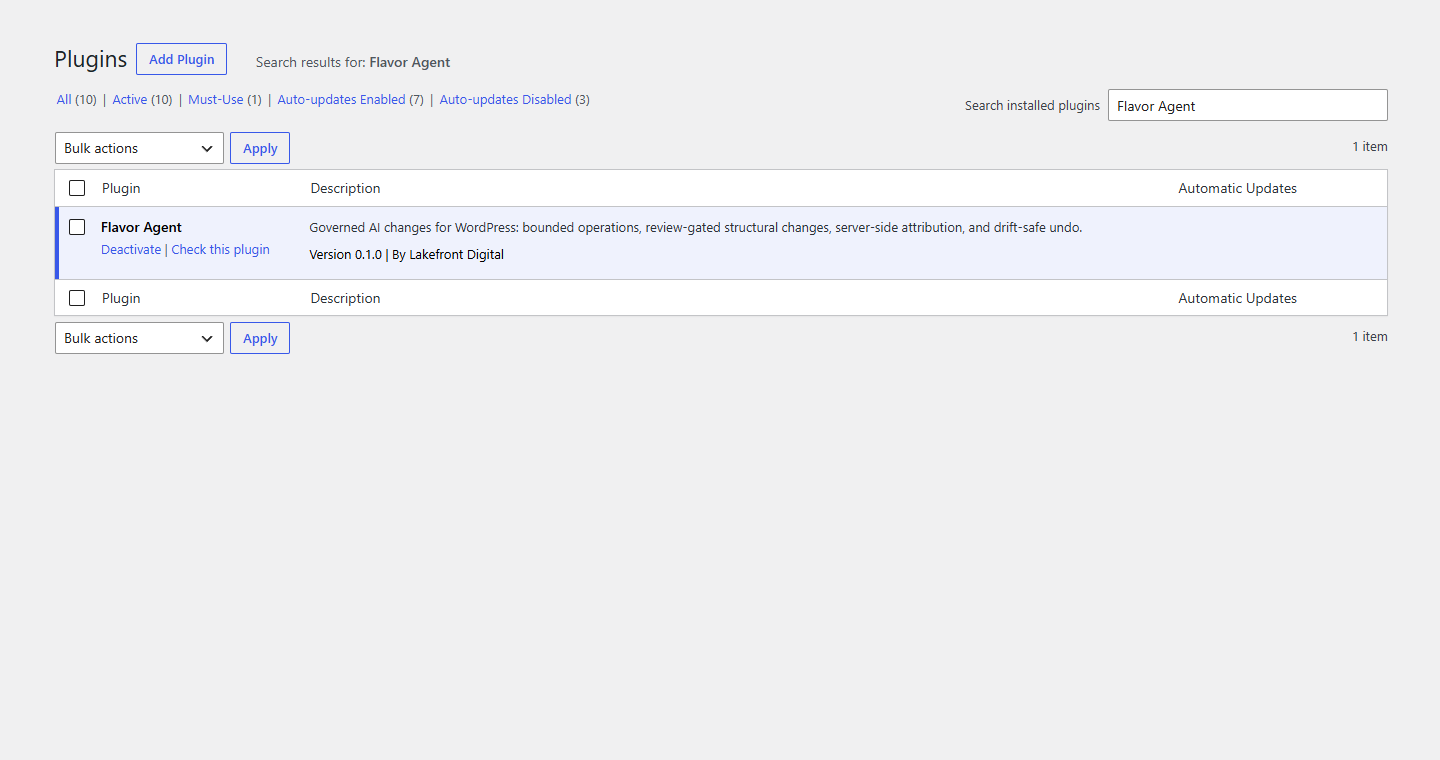
Flavor Agent is a WordPress-native governance layer for AI-mediated changes: bounded recommendations, review-gated mutation, server-side attribution, freshness checks, and drift-safe undo.
The demo principle is simple: AI can request style work and inspect its trail, but approval remains a WordPress admin decision.
In-editor (governed UI)
Settings > Flavor Agentreadiness — Connectors-owned text generation plus plugin-owned pattern/docs/embedding configuration.- A Block Inspector recommendation with bounded inline apply and undo.
- A Global Styles or Style Book recommendation in review-first mode.
Settings > AI Activitywith a pending external style apply.- Approve or reject the row; inspect provenance, freshness evidence, before/proposed/after, undo state, and — when a signing key is configured — the row’s attestation verify affordance.
- Pattern recommendations in the native inserter shelf as browse/rank-first.
Programmatic — external agent via MCP
The same governance model an outside agent sees, end-to-end against a live site.
- Discover.
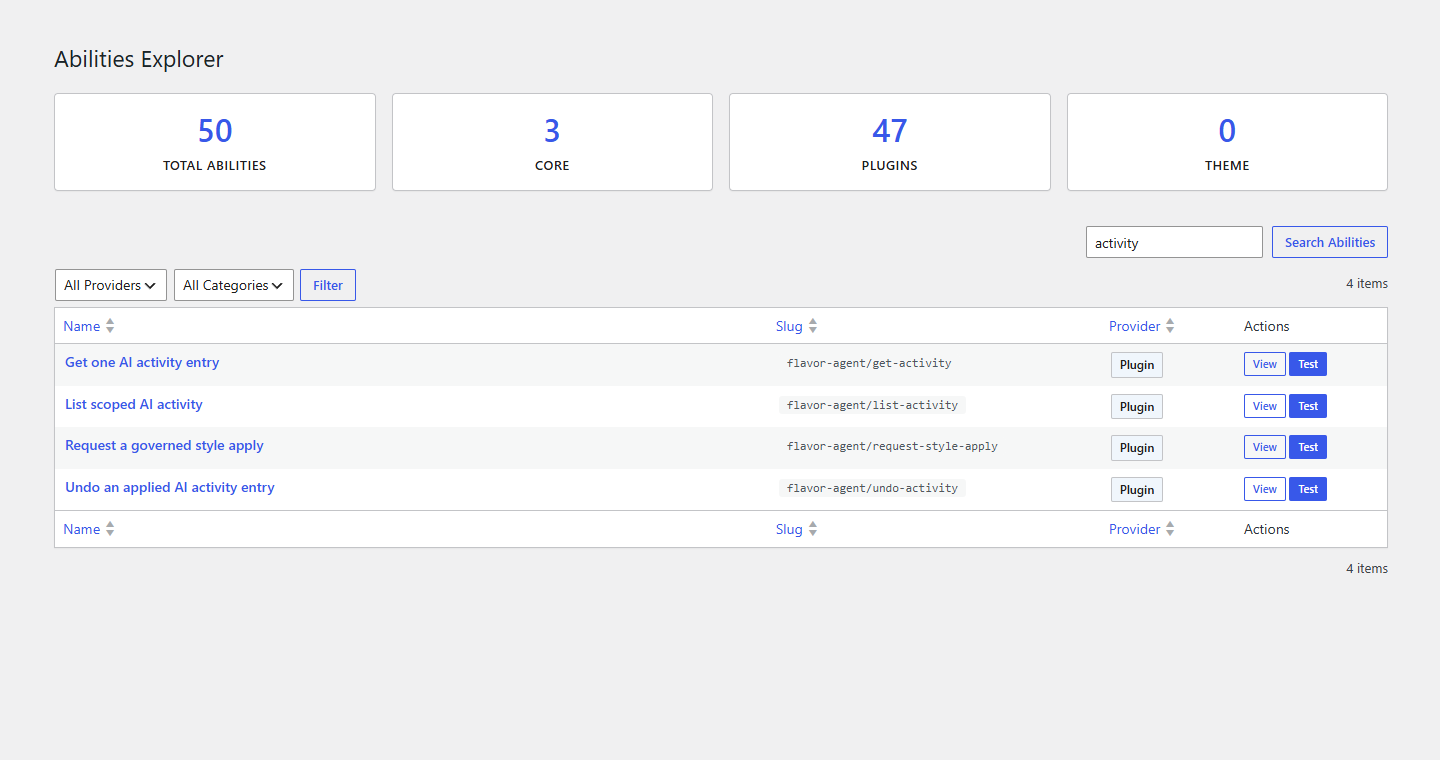
discover-abilitieson the universal default server returns only the read/preview surface (16 public abilities); the sevenrecommend-*and four apply/activity tools live on the dedicatedflavor-agentMCP server. Neither server exposes an approve/decision tool — approval stays admin-only in wp-admin. - Read.
execute-abilityon a read-only ability (e.g.get-active-theme, or apreview-recommend-*signature preflight) runs without invoking the AI Connector. - Propose.
recommend-stylereturns a bounded, preset-backed operation plus review/apply freshness signatures, and records a diagnostic activity row. - Request.
request-style-applywith the operation, the livecurrentConfig, and those signatures creates a pending row and mutates nothing; stale input is rejected as drift. - Approve. An administrator approves the pending row in
Settings > AI Activity; a second freshness check runs against the live entity before the change applies. - Attest & verify.
get-activityreturns the row’sattestation.verifyUrl; with a signing key configured, anyone can fetch the envelope, JWKS, and live subject-state and verify the Ed25519/in-toto statement independently — no credentials. - Reverse.
undo-activityrestores the before-state when the live document still matches the recorded after-state, and emits a chained revert attestation.
Presenter note: attestation is key-gated — without a base64 Ed25519 secret it records no attestation rather than a fake one. The external MCP client authenticates with a WordPress Application Password over HTTPS.
Flavor Agent feature
Governance, demo, and proof as one operating surface
The AI Governance and Demo pages describe one Flavor Agent demonstration: AI proposes changes, WordPress records the trail, and approval stays with the site owner.
Feature state
Operational checks
governance
Policy path visible
demo
Product flow visible
The centerpiece evidence is not a successful apply. It is the boundary: external agents can request a governed style apply, read activity, and request undo, but no approval ability is exposed.